Who reads a LinkedIn profile, and how?
Most readers of a profile arrive with a name in hand: from a referral, from a search before a meeting, from a forward inside a buying committee. They check whether the profile holds what the name promised. That check takes seconds. It ends in reading on or moving on.
This changes the task. A profile does not need to get louder, and it does not need to surprise anyone. It needs to be understood correctly, in a short time, by a prepared reader. The check is easy to underestimate because you never learn its outcome. The reader who moves on leaves no message. How wide the gap between ability and outside perception can grow is described under reputation gap.
In what order does a visitor see the surfaces?
A profile has six surfaces, and visitors see them in a fixed order: banner, photo, headline, about section, experience, contact path. LinkedIn itself recommends seven profile sections for a complete profile. Building the surfaces in reading order means building first what gets seen most.
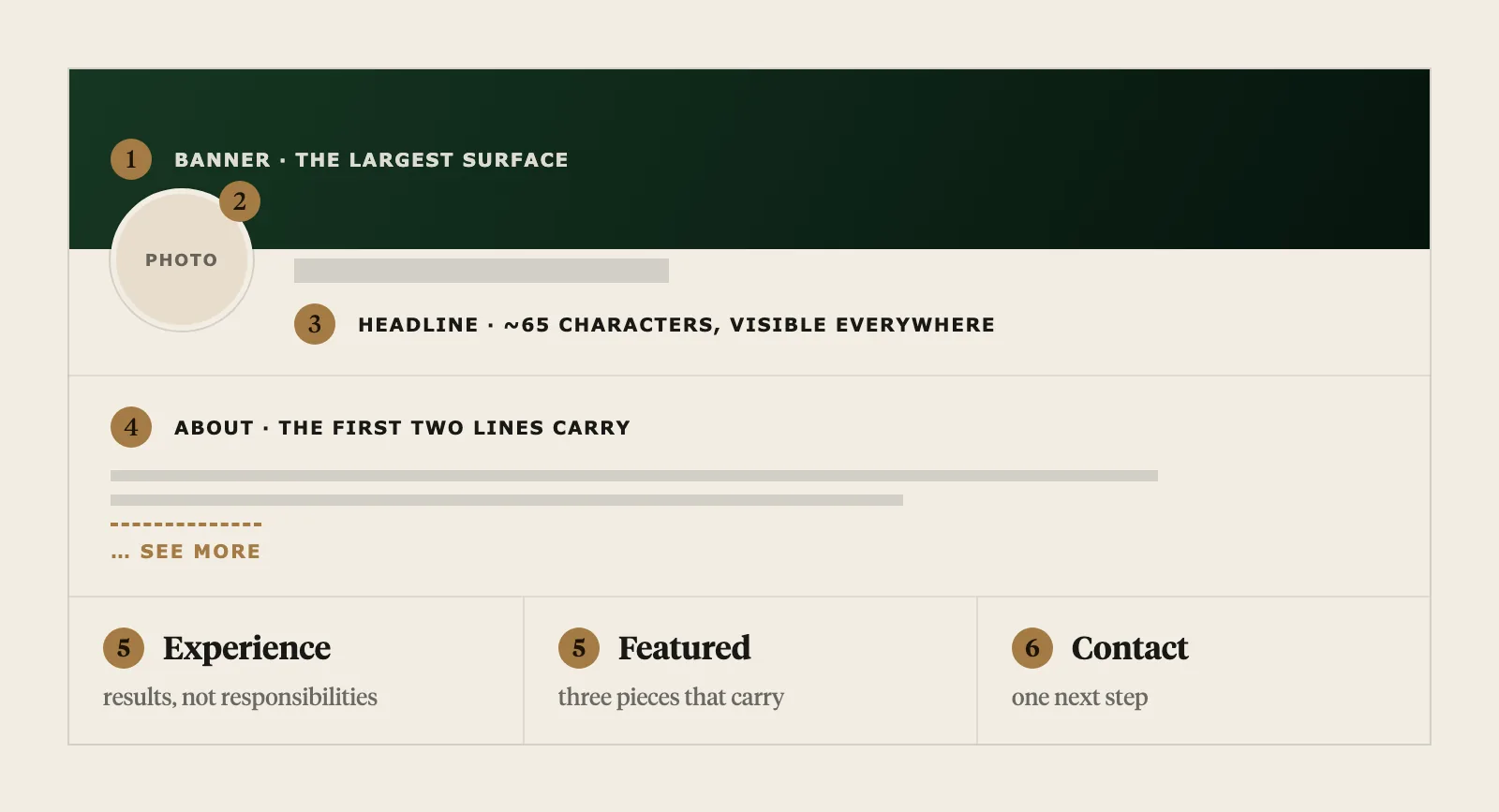
The order doubles as a priority list for any rework. Little is gained when the about section is sharp but sits below an empty banner and a job-title headline. By then the reader has moved on. Each of the following sections covers one surface, with the check questions that reader brings.
What matters for photo and banner?
The photo is the smallest and most seen surface of the profile: in a comment column it shrinks to a few millimeters. The check question follows from that: is your face still recognizable at that size? LinkedIn puts a number on this surface itself: with a photo, a profile receives up to twice as many views.
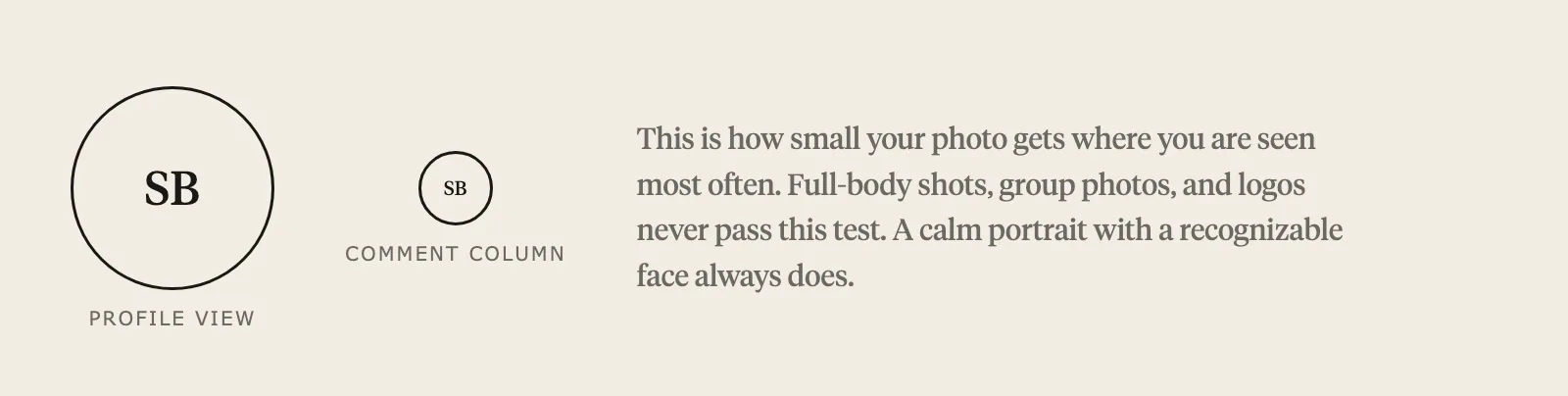
Full-body shots, group photos, and logos never pass the millimeter test. A calm portrait with a recognizable face always does. The banner is the counterpart: the largest surface of the profile. In the profiles that reach Builderz, it is also the one most often left empty. A skyline, a handshake, or the default blue tells the reader that nobody made a decision here. The surface needs exactly two things: an image from your working world and one line that names you. It needs no more, and anything less gives the space away.
What does the headline have to do?
The headline travels everywhere: under every comment, in every search, in every inquiry. Only the first 65 or so characters are visible. That is where your vertical belongs, followed by the hardest proof you can stand behind.
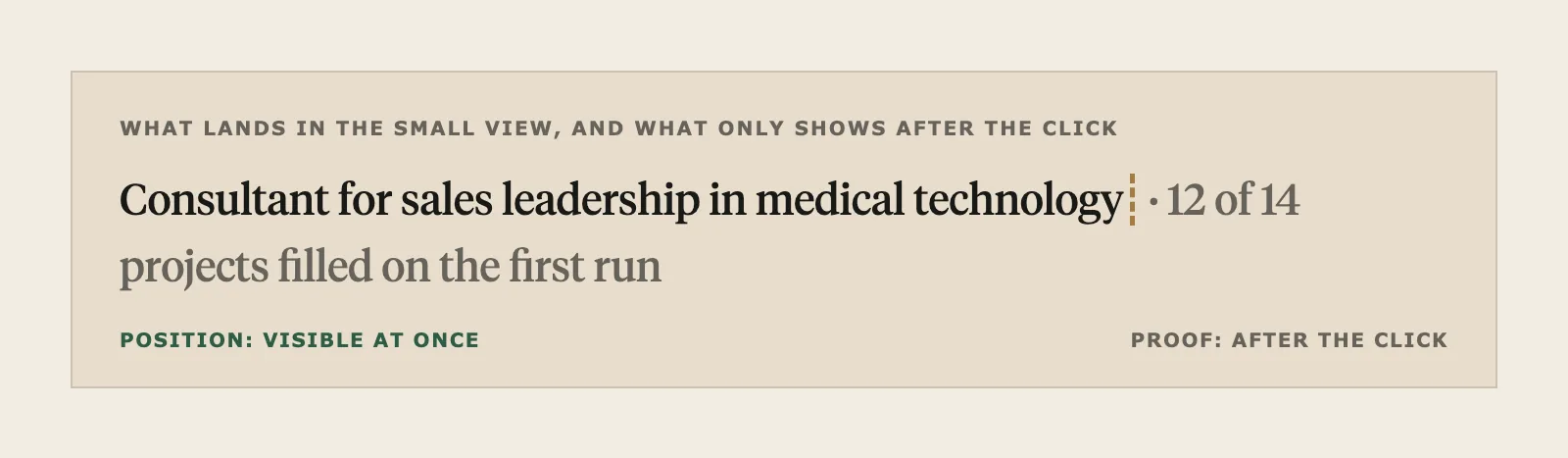
A job title does not do that job. Neither does a string of emojis or "your partner for tailored solutions": readers sort both out as templates. The test is simple: if your headline could sit on top of a competitor's profile, it does not carry a positioning yet. The full guide, including the most common failure patterns, is in the article on the LinkedIn headline.
How is an about section built that carries weight?
Before the click on "see more", only the first two lines are visible. If they hold your years of experience or a stock phrase, the check ends right there. The first two lines must say what you do and for whom.
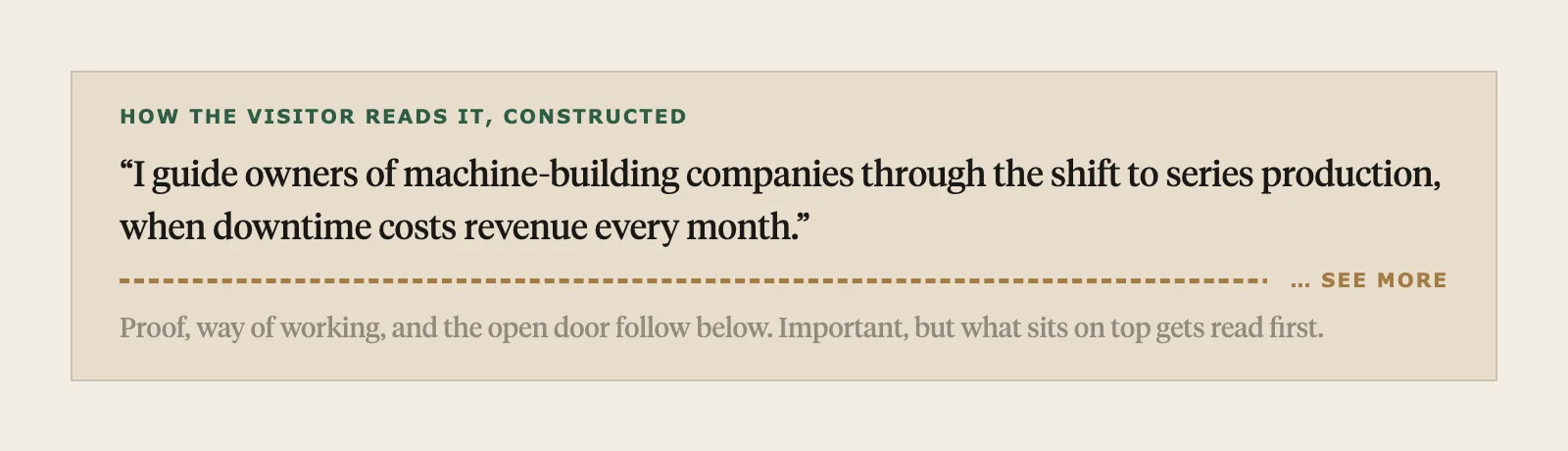
After that, the section has an order that works for every reader:
| Block | Content |
|---|---|
| 1 | Who you serve and for whom: two sentences in your target clients' language |
| 2 | The proof: your two or three strongest lines, results rather than activities |
| 3 | How you work: told as a way of working, not stated as a claim |
| 4 | The open door: one sentence on how to start a conversation with you |
Proof sits before the click, not behind it. Why this section is the hardest writing task in the profile is covered in the article on the about section.
What belongs in the experience and featured sections?
The experience section gets skimmed with one question: does the story match the headline? Your current position is not a job description. It is the second chance to show your proof. Results beat responsibilities.
"Responsible for projects and client relations" tells nothing. An entry that shows numbers and origin continues the line that headline and about section started. For the featured section, three pieces are enough: your best piece of work, one proof from the outside (press, a talk, an award), and the way to reach you. If no strong piece exists yet, the slot stays empty on purpose instead of being filled with something random.
Why do contact path and consistency decide at the end?
The last check is the most mundane, and it decides whether interest becomes a conversation. Two questions remain: does the reader find a next step? Does the profile tell the same story everywhere? In a trust business, consistency is not a cosmetic criterion.
The pass takes ten minutes:
- Profile URL changed to your name, not the string of digits
- Website or email visible, not just "send message"
- The open door sits as the last line of the about section
- Headline, about, and experience tell the same niche
- Numbers carry the same value everywhere
Whoever leaves contradictions standing gets measured by them, not by their best lines.
Rework it yourself, or have it written?
Both work. Only the division of labor differs. Positioning belongs to the person, execution can be delegated. Having it written pays off when the substance exists but the time and the craft do not.
| Route | Fits when | Limit |
|---|---|---|
| Rework it yourself | you have the time, the profile needs sharpening | costs hours, no outside view |
| AI as a tool | a fast raw draft is enough | adopts your blind spots, no banner |
| Have it written | the result should stand without the detour | positioning remains your job |
For the first route, optimizing your LinkedIn profile shows what can be changed in an hour. If you consider the third route, check three things. The delivery covers every surface, including banner and experience. The process works without your login details and ends with your approval. And the provider asks questions about your work. A provider who asks you nothing cannot present you. This is exactly the pattern behind The 1h LinkedIn Profile by Builderz: paste your profile and receive banner, headline, about, and experience back finished. Videos walk you through the setup, and access opens to the waitlist first.
The decision is not a matter of taste. Only you know what you stand for. How it reads is a job craft can take over.
Sources and context.
This page uses external sources as context. The framing and terms are Builderz-specific.
Frequently asked questions.
How do I tell that my profile is not carrying its weight?
By the reactions that fail to appear. Referrals do not turn into inquiries, conversations start from zero, and the inquiries that do come in do not match your work. The profile was read, and it lost the comparison.
Is a good profile enough, or do I also have to post?
The profile is the landing page, not the traffic. It decides what visitors find. Posts, comments, and referrals are what bring visitors in the first place. A strong profile without activity only works on the people who were already coming.
Do I have to hand over my login details for a rewrite?
No. A clean process delivers copy and image files that you paste in yourself, with instructions if needed. A provider who asks for your credentials should have a compelling reason.
Will a rewritten profile still sound like me?
With a serious process, yes. The material comes from your own profile and track record, and nothing goes live without your approval. If a draft sounds like someone else, that is a revision request, not the final result.
Keep reading in the library.
Builderz System
Visibility has to become trust.
Builderz builds LinkedIn systems for founders and executives who want to become clearer in the market, not louder.