What sets the About section apart from every other field?
It is the only free-text field in the profile with room for a complete argument. Structured fields like title, company, and dates allow no statement; the About section allows positioning, and is mostly wasted on a career timeline.
That is both an advantage and a demand. Use it as a positioning text and you can convey the essentials in three paragraphs: what you work on with this person, what sets them apart, what a sensible next step is.
AI search engines, too, draw especially on the About section for their summaries. So it is not only text for humans but part of the executive profile that works as a whole.
What is the most common mistake in the About section?
Writing for no audience rather than the wrong one. Most texts list stations chronologically. That is a CV, not a positioning text.
A CV answers "what have you done?". A good About section answers "why are you the right person for my problem?". That question is asked not by a recruiter but by a customer, investor, or partner.
The difference is perspective. Chronological looks back; positioning looks at the reader and their problem.
How is an About text that works structured?
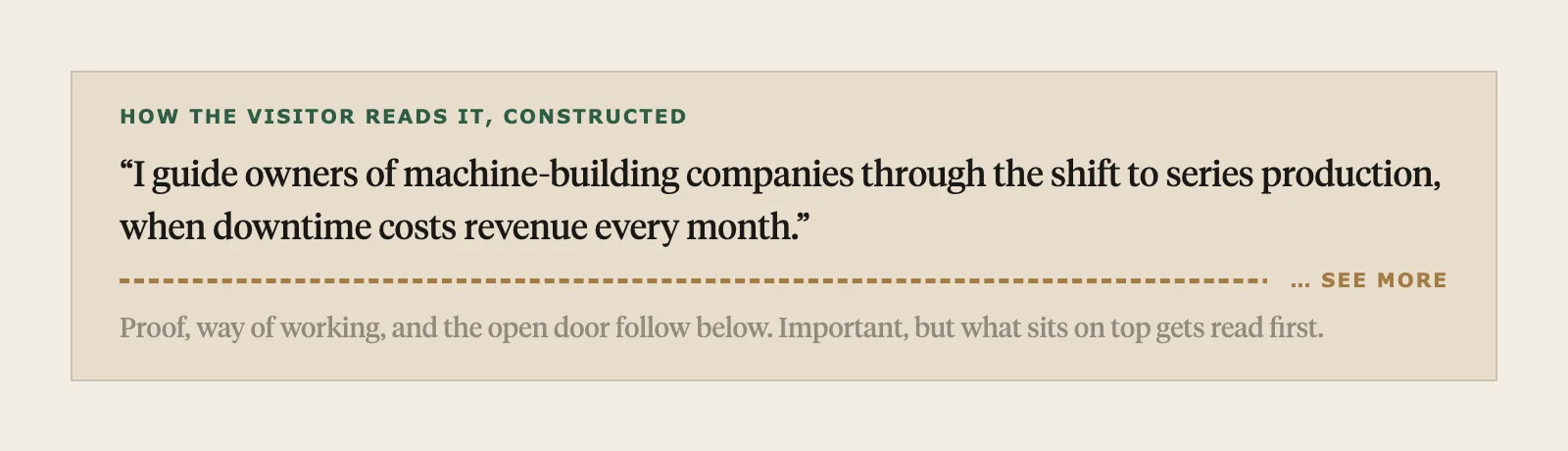
In three reading moves. First paragraph: audience and task, brief and without a list. Second paragraph: the proof. What was done repeatedly, which results are typical? Third paragraph: one concrete next step.
This structure is not elegant but effective. It answers the three questions that decide: is this relevant to me? Does the person have experience? What do I do next?
Each question gets one paragraph, not all at once, not delayed.
Why are the first two lines decisive?
Because LinkedIn shows only two or three lines before "see more" appears. Those lines have to work like a headline: they decide whether the reader clicks.
Many texts open with "welcome to my profile" or "I have been in the industry for 20 years." Both waste the one moment that decides whether someone reads on.
The headline carries the same job one level up, both decide in seconds whether someone stays.
Why is the About section the hardest writing task?
Because it has to hold permanently, with no topicality to lean on. It forces precision: what is stable enough to still be true in a year? That question is harder than a single post.
Many put the About section off because it requires positioning work. You cannot write a good text without knowing what you stand for.
That makes it a diagnosis: if you cannot write it, you do not yet have clear positioning. Write it, and you see what is still missing.
Frequently asked questions.
How long should the about text be?
As long as needed, as short as possible. Three tight paragraphs usually suffice. The first two lines decide, because LinkedIn hides the rest at first.
Write in first or third person?
Usually first person. It feels more personal and fits a personal brand. Third person sounds like a company profile and creates distance that does not help here.
Should you put contact details in the about text?
Yes, at the end. A clear line on how and why to reach you belongs with the reason to talk. But it does not replace the actual positioning text before it.
How often should you update the about text?
When positioning changes, not by calendar. A good about text is built to last. It should still hold a year later without needing edits.
Keep reading in the library.
Builderz System
Visibility has to become trust.
Builderz builds LinkedIn systems for founders and executives who want to become clearer in the market, not louder.