What must a LinkedIn profile do before someone reaches out?
An executive profile has to answer three questions at once: what does this person stand for? Why should I take their judgment seriously? What is worth a conversation? Leave these open and the feed has to do more work than necessary.
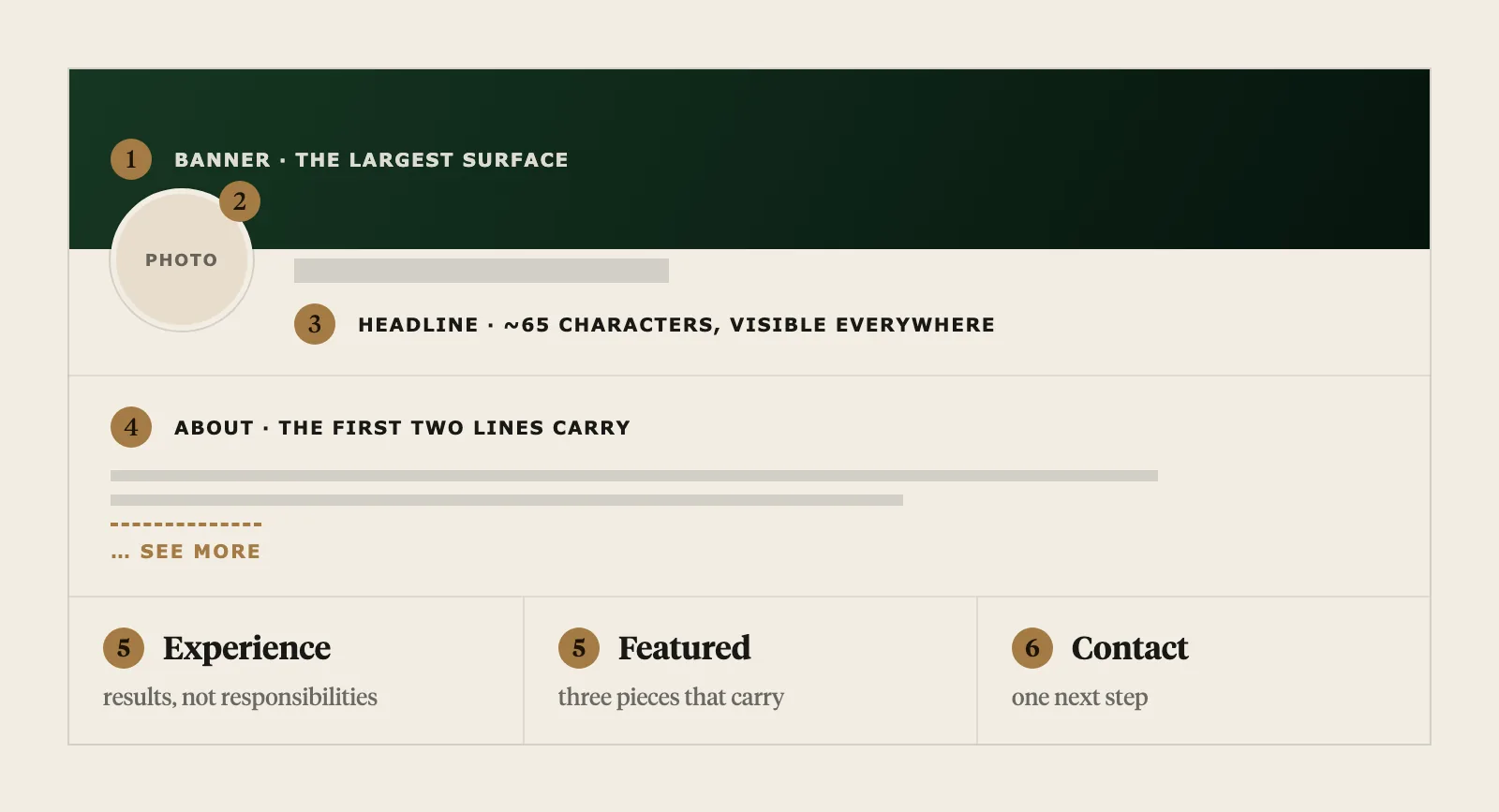
The profile is therefore not a digital business card but a landing page. It is often the first place where customers, talent, or partners check whether a person feels relevant and worth approaching.
A good profile answers that check in seconds, not through completeness, but through clarity. The four building blocks below decide it.
Why does the headline need a position, not a job title?
Because a title explains function, a position explains relevance. For founders the headline is therefore a strategic sentence, not a CV field. It should not say everything, but open the right door.
A job title answers "what are you?". A position answers "why should I listen to you?". The second question decides whether someone reads on.
How such a headline is actually built is covered in detail in the LinkedIn headline.
How should the about section be structured?
Not chronologically, but by a clear logic: problem, perspective, proof, reason to talk. That way a reader understands faster why the person might matter to them. A CV tells the past; a good about section tells relevance.
Most profiles open with their own story. Better ones open with the reader's problem and only then introduce the person who solves it.
Structuring such a text is covered step by step in the LinkedIn about section.
Why must the profile match the content?
Because profile and feed have to create the same picture. The profile promises a position; the feed proves it. If the two diverge, friction forms that costs trust.
Appear as a strategist in the profile but only share and congratulate in the feed, and you create a contradiction. The visitor senses it, even without being able to name it.
Profile and content are therefore two halves of the same statement, the basis of any durable reputation.
What makes a profile credible rather than merely complete?
Evidence. Recommendations, concrete results, and a recognizable trace in the feed work more strongly than a flawlessly filled-out profile. Completeness is the duty; proof is the difference.
A profile without an outside voice only claims. A recommendation from the right person confirms, and confirmation weighs more than self-description.
Which fields count in detail, and in what order to improve them, is covered in optimizing the profile.
Frequently asked questions.
How long should the about section be?
As long as needed, as short as possible. The first two lines decide, because LinkedIn hides the rest at first. They have to create relevance before someone clicks 'more'.
Do you need a professional photo?
Yes, but not a studio shot. A clear, friendly photo in fitting attire is enough. More important than perfection is that the image matches the position and the audience.
Should the profile be in German or English?
By audience. If you mainly operate in DACH, write German; if you work internationally, English. LinkedIn also allows bilingual profiles for mixed audiences.
How often should you update the profile?
When position or focus changes, not by calendar. A profile is not a CV updated yearly but a statement that has to match your current work.
Keep reading in the library.
Builderz System
Visibility has to become trust.
Builderz builds LinkedIn systems for founders and executives who want to become clearer in the market, not louder.