What is reputation, and how is it different from visibility and reach?
Reputation is the judgment a market reliably calls up the moment a person's name comes up. Visibility and reach are only its precondition, not its result. They say how often and how far someone is seen. Reputation begins only when attention turns into a category.
The three terms are often treated as one, though they measure different things.
| Term | What it measures |
|---|---|
| Reach | How many people a post reaches |
| Visibility | Whether a person is present in the market at all |
| Reputation | The judgment that remains after several encounters |
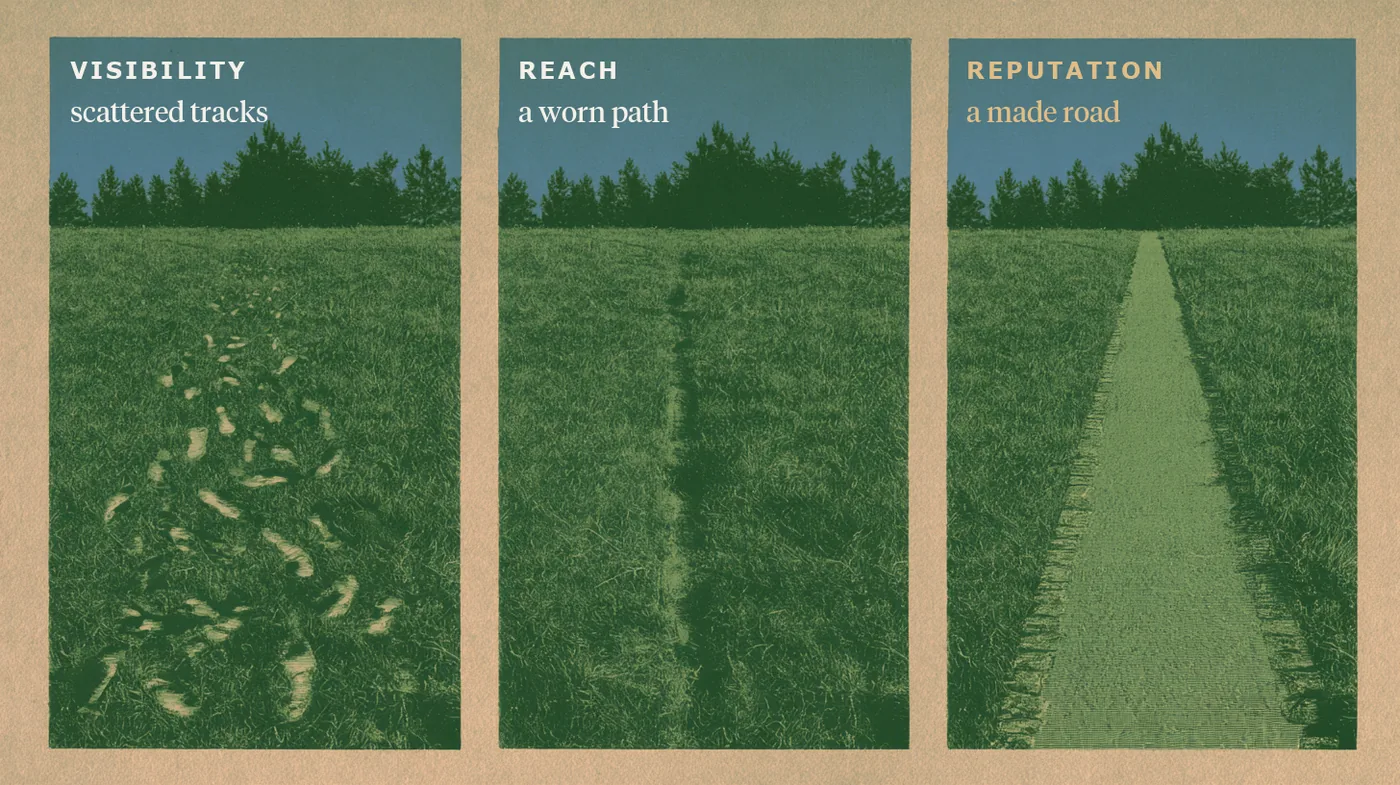
Reputation, in this sense, is a memory. The market stores what a person reliably gets right. It recalls that the moment their name appears in a decision. Reach does not create that memory; it only makes more people glance for a moment. Whether anything stays is decided by the repetition of a clear line, not by the number of impressions.
For founders, this distinction decides what their presence is worth. Many carry a reputation gap: their actual capability is larger than their public picture. Reach alone does not close it. Broad visibility without a clear profile only makes it more obvious. Reputation also cannot be designed as an image. It is earned as a judgment is confirmed over time.
Why is visibility alone not enough for reputation?
Visibility alone is not enough because attention without a category dissipates. Someone who is seen but leaves no clear category in the market's mind stays interchangeable. Reach does not change that.
Visibility is only the room. You can fill it and still feel generic if every post raises a different topic. Reach then produces impressions but no recognition. The market sees a lot and remembers little.
A common pattern shows it: a founder posts daily: leadership one day, sales the next, technology after that. Reach rises; the category does not. Months later, readers remember individual posts but not a stance. She was always visible; she was never positioned.
The honest test is simple: what can people say about a person after several touchpoints? If the answer is only that they publish often, reputation is missing. If the answer is that this person demonstrably understands a particular problem better than others, it has formed. That second answer is the goal of any serious presence.
How do you build reputation systematically?
Reputation comes from three things: a recognizable topic line, repeated proof, and substance over frequency. Anyone who owns the same question for months, from several angles, becomes legible to the market.
- A recognizable topic line. A strong voice returns to a few core themes instead of switching topics every week. This topic leadership is the difference between an archive of isolated opinions and a position people recognize.
- Repeated proof. Every claim is backed by a situation, a number, or a concrete decision. A proof post shows judgment in action, by laying out a decision and its outcome, for instance, rather than offering generic advice.
- Substance over frequency. Cadence helps only when it reinforces a line. Without one, more output mainly creates more noise. In one Builderz case, 20 posts at a weekly cadence produced +270% followers in 19 weeks, not through volume, but through a consistent line. That is why personal branding for founders puts substance before the content calendar.
These three work together, not alone. A topic line without proof stays an assertion; proof without a line stays a collection of anecdotes; frequency without either only amplifies the noise. Only in combination do posts become a position.
The guiding question then shifts from "what do we post?" to "which conversations should our presence make easier?" Topics, formats, and tone follow from the answer, not the other way around. Building reputation is first a decision about focus, before it is a question of reach.
Why is reputation a trust factor in B2B, and what does the research show?
In B2B, reputation decides whether a conversation starts with trust or from zero. Decision-makers read a person's judgment before they buy: according to Edelman and LinkedIn (2025), 64% of decision-makers trust thought-leadership content more than marketing materials when assessing a vendor's capabilities. And only about 5% of a market is in-market at any given time (the 95-5 rule), so reputation works long before the need arises.
The reason lies in the buying process itself. Under the LinkedIn B2B Institute's 95-5 rule, the large majority of a market is not ready to buy at any moment. Whoever becomes visible only when the need arises enters a decision that was internally prepared long before.
The higher the stakes of a decision, the more the prior judgment weighs. Choosing an interim manager, an advisor, or a partner carries risk. The buyer looks for reasons to trust someone before committing. A visible way of thinking lowers that risk before the first conversation. Without it, every contact starts cold, often with price as the only point of difference.
There is also the buying committee: several people shape a B2B decision. Many of them never appear in the conversation. 95% of these hidden buyers say strong thought-leadership content makes them more receptive to a conversation (Edelman and LinkedIn, 2025). Good public thinking gives them language and arguments that travel internally. How substance becomes trust is covered in B2B thought leadership.
How do you measure whether reputation is forming?
You do not measure reputation in likes, but in harder signals: qualified profile visits, inquiries that carry context, and a noticeable conversation advantage. In one Builderz case, profile visits rose from around 70 to over 1,000 across roughly two years, a harder signal than any like count. The decisive question is whether public presence creates conversations that would not have happened otherwise.
Likes and reach are easy to count and say little about trust. More telling is who reaches out, and in what frame of mind. An inquiry that picks up a position from a post is a stronger signal than ten thousand impressions with no follow-up. This conversation advantage is the real goal.
It helps to rank the signals: impressions show reach, profile visits show interest, qualified inquiries show trust. Only the third is reputation in measurable form. Chase the first alone and you optimize the easiest number, not the most important one.
It also helps to watch the signal-to-noise ratio: how much of the attention is relevant to your own market? Reach in the wrong audience is not progress, only a larger number. Which metrics actually count, and how to read them, is covered in measuring visibility.
How long does it take to build reputation?
Reputation grows over months, not weeks. A realistic horizon is six to twelve months of consistent, topic-coherent presence before the nature of the inquiries noticeably changes.
The effect is cumulative. Individual posts disappear; a recognizable topic line remains and compounds with every repetition. Consistency beats intensity here: a calm, reliable voice over years does more than a short, loud burst. In one Builderz case, five years and roughly 130 posts turned an account that was once dismissed into a voice whose stance clients know before the first conversation begins, documented in the Dieter Leikermoser reference.
In the first weeks, little happens visibly, and that is normal. The effect usually becomes tangible only when the same themes appear for the third or fourth time. Readers then begin to attribute them to the person. From that point, the nature of the inquiries changes, from "what is it you do?" to "can you help with this specific problem?"
What mattered in that case was not reach in itself, but that the right people knew what the person stood for. Why depth comes before breadth is covered in personal brand without large reach. And what built reputation returns beyond inquiries is laid out in reputation as currency.
Sources and context.
This page uses external sources as context. The framing and terms are Builderz-specific.
- Edelman and LinkedIn: 2025 B2B Thought Leadership Impact Report
- LinkedIn B2B Institute: the 95-5 Rule
Frequently asked questions.
Can you build reputation without writing yourself?
Partly. Substance and judgment have to come from the person and cannot be outsourced. Editing, structure, and distribution can be. A good ghostwriting process makes a point of view visible; it does not invent one.
Does AI change how reputation is built?
AI lowers the cost of text, not of judgment. The more abundant well-written posts become, the more a sourced, genuine perspective is worth. Reputation still comes from substance a person can actually stand behind.
Is a strong profile enough, or do you need to keep posting?
A strong profile decides the first impression but does not build reputation on its own. Reputation comes from repetition, recurring themes and proof over time. The profile is the stage, not the performance.
Does building reputation work without large reach?
Yes. In a clearly defined market, depth with the right people matters more than reach. A few hundred relevant readers who know what someone stands for outweigh ten thousand who do not.
Keep reading in the library.
Builderz System
Visibility has to become trust.
Builderz builds LinkedIn systems for founders and executives who want to become clearer in the market, not louder.