What must the LinkedIn headline actually do?
It has to say in one line who the profile is relevant for and why, not what the role is called. The headline is the text read most often before anyone opens the profile: below the name in search results, in comments, in AI answers.
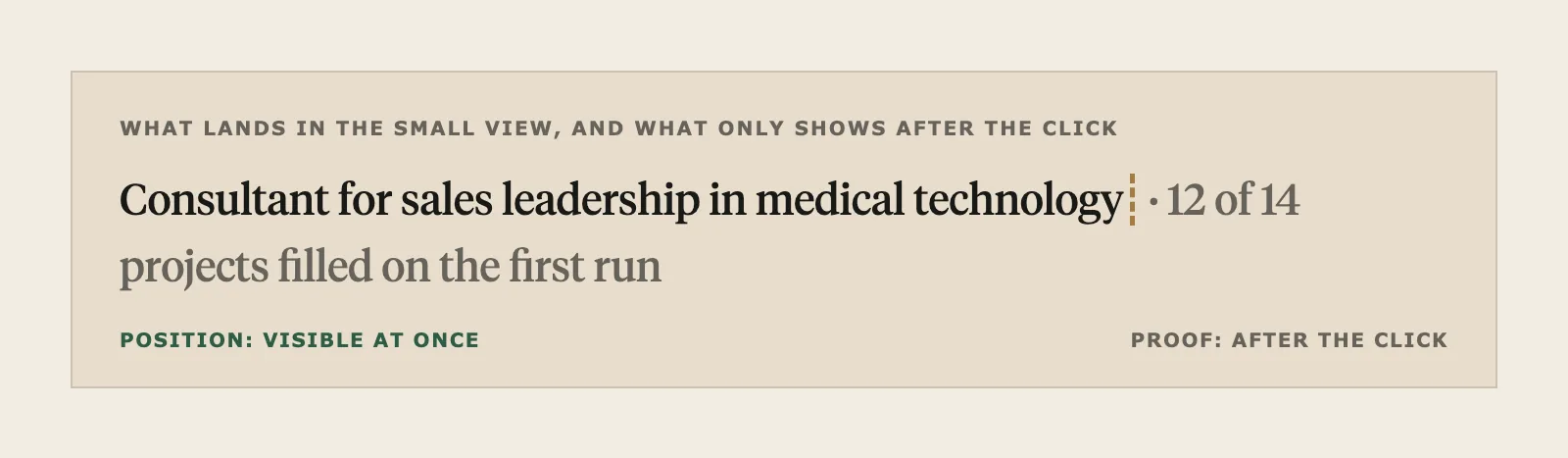
That makes it the most important line in the profile. It identifies the audience and gives a first reason why the person matters to them.
That sounds simpler than it is, and usually fails on a misunderstanding about who the headline should address.
Why is the headline not a job title?
Because a job title says what the role is called, while a headline says what the person's judgment stands for. "Managing Director at Firma GmbH" is not a mistake; it is emptiness.
Write the headline for recruiters and you write it right: job title, company. Write it for customers, partners, or the relevant market and you need something else.
The question is not "who am I?" but "why should someone in my audience read on?". That question leads to positioning, not a title.
Which mistakes are most common?
Three patterns dominate: the plain job title, the list variant with pipe-separated terms, and the motivational claim ("I help people unlock their potential"). Each is weak for a different reason.
The list tries to hit several audiences at once and communicates breadth instead of depth. In a market where specificity builds trust, that is a weakening.
The motivational claim avoids any commitment. It sounds inviting but reveals nothing about judgment, experience, or context, and gives the reader no anchor.
Why do search and AI weight the headline so heavily?
Because it appears right next to the name: in the preview, the snippet, in cited profiles. It is the line almost every system reads first.
AI search engines look for citable sources for specific questions. A headline with no usable information lowers the chance of being named as an answer.
How that mechanism works is covered in AI on LinkedIn. The headline is the smallest unit where it becomes visible.
What does a good headline come from?
From clarity, not creativity. The headline is compressed positioning, the result of asking which question you want to own in the market, and what experience earns the right to it.
A useful exercise: what would a contact say if someone asked "what exactly does this person do?". Concrete enough that the answer leads somewhere? If it stays vague, the headline is not precise enough yet.
So it is not the first step of the profile but the result of positioning. A good starting point is the about section: describe clearly there what you stand for and you have the basis for a headline.
Frequently asked questions.
How long can the headline be?
LinkedIn allows up to 220 characters. What matters is not length but that the first half alone shows position, in many views the headline is truncated.
Should you put keywords in the headline?
Yes, but as language, not a list. Terms your audience searches for belong there, embedded in a clear statement, not as a pipe-separated list.
Do emojis belong in the headline?
Sparingly and only functionally. An arrow or separator can give structure; a row of decorative emojis quickly looks arbitrary and weakens a serious position.
Headline in German or English?
By audience, consistent with the profile. Selling in DACH, write German; operating internationally, English. A language mix in the headline costs clarity.
Keep reading in the library.
Builderz System
Visibility has to become trust.
Builderz builds LinkedIn systems for founders and executives who want to become clearer in the market, not louder.