Personal brand vs. company brand: what is the difference?
Personal brand and company brand both build trust, but different kinds. The company brand provides stability, offer, and context; the personal brand makes judgment, experience, and proximity visible. They are not opponents but two jobs.
| Aspect | Company brand | Personal brand |
|---|---|---|
| Explains | the system and offer | the judgment and the person |
| Trust from | reliability and processes | experience, proximity, point of view |
| Strongest when | many people and products work together | trust in people decides |
| Weakness | quickly feels distant | hangs on a single person |
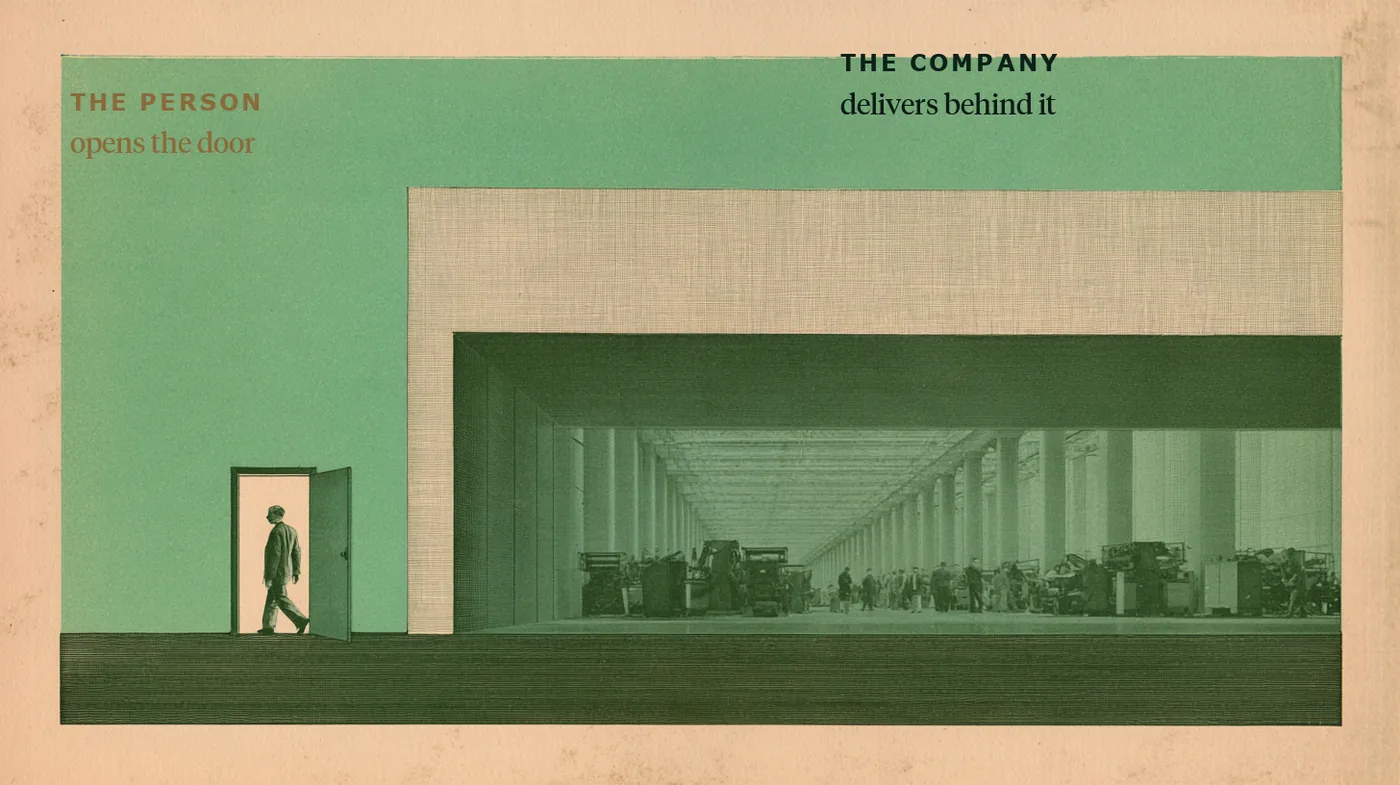
The two are strongest together, when each takes its job. How a strong personal brand forms is the harder half, because it hangs on a person.
What does the company brand do?
The company brand explains the system. It shows what a company offers, what it stands for, and why it is reliable. It is strongest when several people, processes, and products work together.
Its strength is stability. A company brand outlasts individuals, carries guarantees, and makes an offer comparable and predictable.
Its weakness is distance. In advisory or explanation-heavy businesses especially, a pure company brand feels abstract. It lacks the face people trust.
What does the personal brand do?
The personal brand explains the judgment. It shows how a specific person thinks, decides, and takes responsibility. That becomes important when buying, hiring, or partnership depend heavily on trust in people. According to Edelman and LinkedIn (2025), 64% of decision-makers trust a person's demonstrated judgment more than marketing materials.
Its strength is proximity. People follow people, not logos. A person makes tangible what a brand only claims.
Its weakness is dependence: it hangs on a single person. That is exactly why reputation rests on evidenced judgment, not on a performance.
How do the two brands support each other?
They support each other by each taking its job. The person must not appear larger than the company can carry; the company must not become so abstract that no one speaks. Good architecture distributes the jobs cleanly.
The personal brand gives the firm a face and a judgment. The company brand gives the person stability and an offer trust can attach to.
Where that works, they reinforce each other: the person's judgment makes the firm credible, the firm makes the judgment durable.
What is the wrong expectation, and the right order?
The wrong expectation is replacement. A personal brand does not replace a website; a company brand does not replace visible leadership. Play one against the other and you weaken both.
For most founders, the right order is: first the personal brand, which opens trust and conversations, then the company brand, which keeps the promise. The person opens the door; the company delivers behind it.
Which brand should lead in your own positioning depends on the business. A good system settles that before the first post, as choosing a LinkedIn agency shows.
Sources and context.
This page uses external sources as context. The framing and terms are Builderz-specific.
Frequently asked questions.
Build a personal brand or company brand first?
For most founders, the personal brand first. It opens trust and conversations faster, especially when the company brand is still young. The firm then delivers what the person promised.
What happens to reputation when the founder leaves the company?
It goes with the person, not the firm. That is a risk for the company but not an argument against personal brands, rather for an architecture in which both brands carry trust.
Do large companies also need personal brands?
Often yes. In explanation-heavy B2B especially, trust in visible leadership decides. A strong company brand does not replace that; it complements it.
Do personal brand and company brand compete for the same budget?
Only in appearance. They have different jobs and reinforce each other. Play them against each other and you weaken the whole picture. The question is not either-or, but which brand carries which job.
Keep reading in the library.
Builderz System
Visibility has to become trust.
Builderz builds LinkedIn systems for founders and executives who want to become clearer in the market, not louder.