What distinguishes inbound from outbound on LinkedIn?
The difference between inbound and outbound is not the direction of the message but the starting point of trust. Outbound starts from zero: someone writes to a person they do not know. Inbound starts from trust: someone comes because they are already convinced.
| Aspect | Outbound | Inbound |
|---|---|---|
| Starting point | from zero | from trust |
| First question | "Can you do this?" | "Does this fit us?" |
| Effort | outreach, qualification | groundwork long before |
| Contacts | cold | pre-qualified |
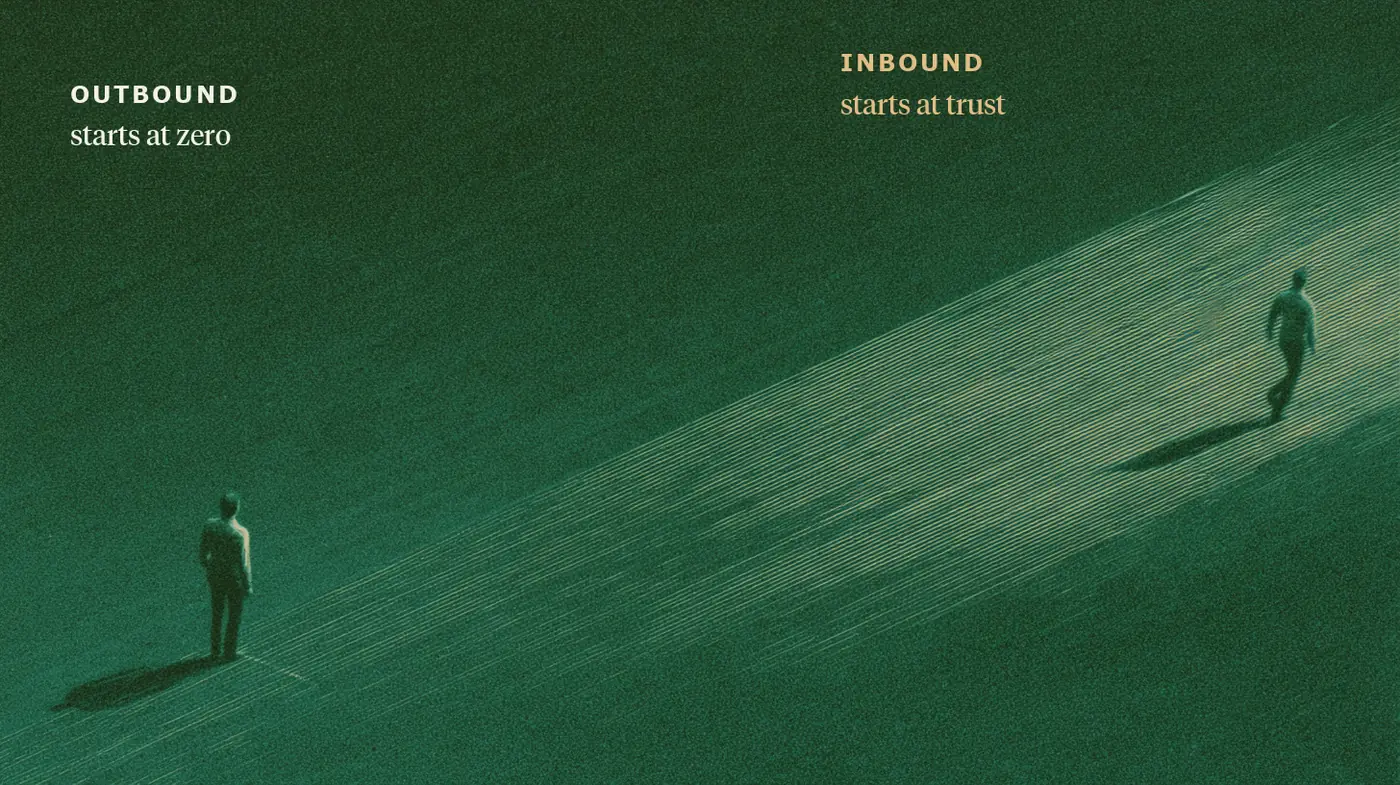
That changes the quality of the first conversation entirely. Someone who inquires inbound has usually already decided the person is credible. So inbound is an investment, not a shortcut, and it builds on reputation.
How does inbound readiness form?
Inbound does not form after three months of good posts. It forms when a person has been present in a topic over time, consistent enough that the market connects them with a particular question.
Three things must be visible: a clear positioning, a recognizable way of thinking, and a public proof post that the person has applied that thinking repeatedly. Then the market begins to store them.
"Store" does not mean someone bookmarks the profile. It means the name stays in memory tied to a question, and surfaces when that question becomes relevant. This effect comes from repetition, not from one post that went viral.
Which signals point to real inbound readiness?
Real inbound signals are those where the contact exposes themselves. A like is consumption. A comment is engagement. A direct message with concrete context is an inbound signal.
In practice, what counts most: a DM referencing a specific post, a forward by a third party with a note, a call or email referencing a piece of content. These signals rarely come by chance, almost always a public trail can be traced.
What they share: the contact took the trouble to give context. That is exactly what separates inbound from cold outreach. Which signals actually count is covered in measuring visibility.
Why does more activity not accelerate inbound?
More posting rarely accelerates inbound, because inbound forms through depth, not frequency. Post daily without a recognizable line and you produce volume. Volume creates reach, but reach creates no trust.
The common mistakes: too much top-of-funnel content with no stance, too many topics with no specialization, too much focus on the algorithm instead of the quality of the audience. Work that way and you grow visibly, and wonder why the inquiries stay away.
Why depth comes before breadth is covered in personal brand without large reach.
How long does it take for inbound to form?
Inbound forms over months, not weeks. Reputation usually forms in six to twelve months; reliable inbound inquiries tend to follow in the nine-to-eighteen-month range, faster when positioning is clear from the start. In one Builderz case, that consistency compounded over roughly nine months into reliable, qualified inbound.
The full case is documented in the Antje Lenk reference. What mattered was not the number of posts, but the consistency of a recognizable line.
Know that and you think about LinkedIn differently: not as a channel for fast leads, but as a source you build, as the LinkedIn funnel shows.
Frequently asked questions.
Can you measure inbound?
Indirectly. You measure not inbound itself but its precursors: qualified profile visits, inquiries with context, and forwards. These signals show the positioning is landing before the first inquiry arrives.
How do I recognize a real inbound signal?
By the contact exposing themselves and giving context. A DM referencing a specific post is a signal; a like is only consumption. Real signals can almost always be traced to a public trail.
Does posting more often accelerate inbound?
Rarely. Inbound comes from depth, not frequency. More posts without a recognizable line produce reach but no trust, and so no inquiries from the right corner.
Do you still need outbound?
Often as a complement, not a replacement. Outbound can speed up an existing reputation by opening conversations deliberately. Without reputation it stays expensive and cold.
Keep reading in the library.
Builderz System
Visibility has to become trust.
Builderz builds LinkedIn systems for founders and executives who want to become clearer in the market, not louder.