LinkedIn or XING: which platform builds reputation in DACH?
For public reputation work in the DACH region, LinkedIn has the clearer foundation. XING is a career network, LinkedIn a reputation platform. The difference is not the user count but the behavior: who actively reads content, and who is only registered?
| Aspect | ||
|---|---|---|
| Primary purpose | public reputation | recruiting and job change |
| User behavior | read, comment, share content | maintain profile, read jobs |
| Reach | global, DACH and international | mostly DACH |
| Google-indexed | yes | no |
| For reputation work | main channel | passive directory |
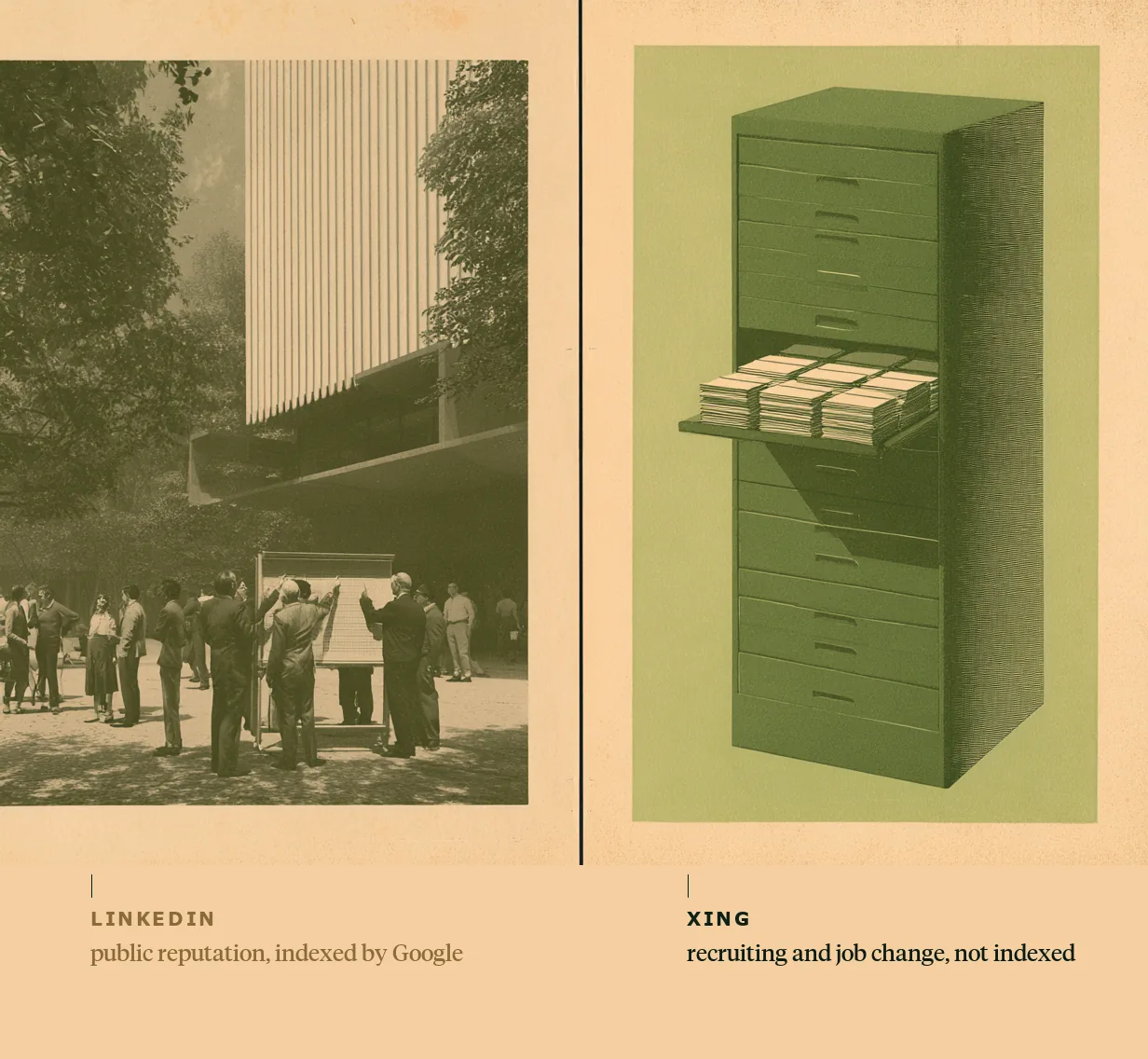
LinkedIn is more globally oriented and, by its own account, has over a billion members. But for reputation, size matters less. What counts is where the audience actually consumes content.
Why is user behavior the decisive difference?
Reputation needs an active audience, not just a registered one. On LinkedIn, far more public content is read and shared. On XING, the primary activity is reading job listings.
For founders building thought leadership, that is the structural difference. A post works only when it is read and carried forward. In a directory it just sits there.
Address mainly German-speaking mid-sized firms and you find contacts on both. Want to work beyond DACH and LinkedIn is clearly better placed.
Why is Google indexing a structural advantage of LinkedIn?
Public LinkedIn content is indexed by Google; XING content usually is not. A substantial post can appear in search results months later. So public LinkedIn activity builds an indexed archive of your thinking.
That has a concrete consequence. Write on LinkedIn and you also reach people who are never on LinkedIn but search via Google. Post on XING and you reach only the XING network.
For reputation work that is a structural advantage. Visibility forms not only in the feed but also in search engines and AI answer machines. AI on LinkedIn amplifies that effect.
When does XING still make sense?
XING still makes sense for specific recruiting scenarios in German-speaking B2B. That holds when the audience is more active there than on LinkedIn. As a primary platform for public reputation work, XING has been too weak for years.
That is not a criticism of XING as a product but an observation about user behavior. Reputation work needs a platform where the audience is not just present but active.
For most founders and executives the consequence is: LinkedIn as the main channel, XING as a passive directory.
Is it either-or, or a question of focus?
The right question is not either-or but where the focus sits. Many founders have profiles on both platforms. That is no problem. The problem arises when energy is spread evenly though the impact differs.
Maintain two profiles and you should treat LinkedIn as the primary reputation channel: active content, strategic comments, a maintained profile. XING can remain a contact directory without active investment.
Energy is finite. Concentrate it on the platform where the audience consumes content and you work more efficiently for reputation. It is the same focus decision as in positioning.
Frequently asked questions.
Should you delete your XING profile?
No, just keep it passive. A maintained XING profile does no harm and serves as a contact directory. Active reputation work belongs on LinkedIn, where content is read and shared.
Which platform gives more reach in DACH?
For public content, clearly LinkedIn. XING has DACH users but little active content distribution. The reach that builds reputation forms where posts circulate, on LinkedIn.
Does LinkedIn work in the German Mittelstand?
Increasingly yes. More and more decision-makers in German-speaking mid-sized firms read and react on LinkedIn. Being present with substance there first leaves little competition in many niches.
LinkedIn or XING for recruiting?
Either can, depending on the audience. For German-speaking B2B recruiting, XING can be a useful complement. For public employer reputation and international search, LinkedIn is superior.
Keep reading in the library.
Builderz System
Visibility has to become trust.
Builderz builds LinkedIn systems for founders and executives who want to become clearer in the market, not louder.